
J. W. Whiting & R. E. Relph
J. W. Whiting and R. E. Relph co-authored the report The Occurrence of Opal at Lightning Ridge and Grawin, with Geological Notes on County Finch, one of the earliest thorough studies of geology on the Lightning Ridge and nearby opal fields. An excerpt of The Occurrence of Opal can be found on the opal.academy website.

J. W. Whiting
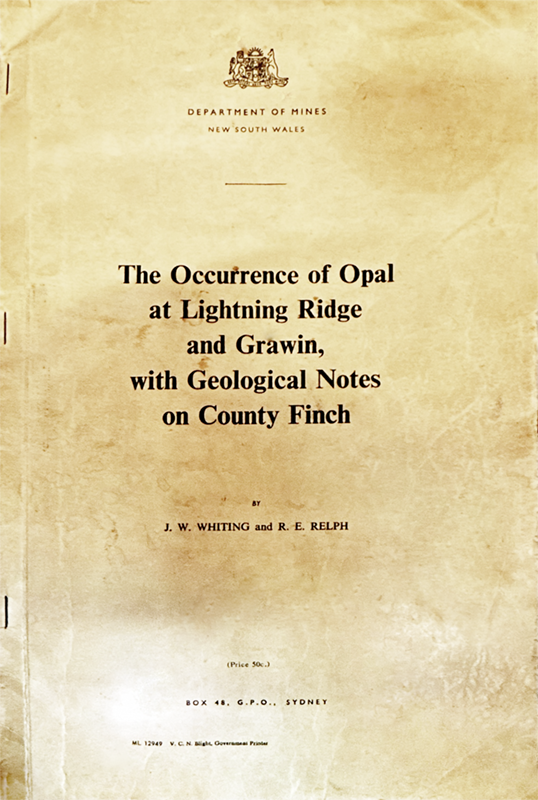
The Occurrence of Opal, 1958.
Joseph William Whiting was a geologist and palaeontologist who worked for the New South Wales Department of Mines in the 1940s and 1950s.
J. W. Whiting was born in Walcha, New South Wales, in 1912. His parents were Ethel and Thomas. He was educated at the University of Sydney. He was married in 1939.
In 1947, Whiting participated in research into fossilised clam shells found near Thuddungra, New South Wales. In 1950, he recorded significant data on fossils from the silurian period (443.8-419.2 million years ago) near Jackadgery, New South Wales.
In 1958, The Occurrence of Opal at Lightning Ridge and Grawin, with Geological Notes on County Finch was published, covering the extensive geology of the Lightning Ridge area, and surrounding county.
J. W. Whiting passed away in 1990 at the age of 78.

R. E. Relph
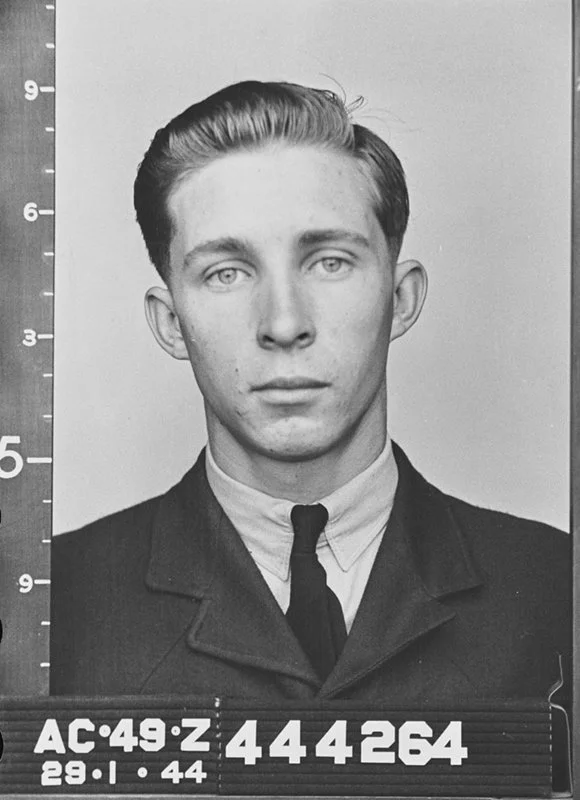
R. E. Relph’s military service image. Photograph: National Archives of Australia.
Richard Edward Relph was a geologist with the New South Wales Department of Mines and later a consulting geologist, whose work contributed to the mid-twentieth-century geological interpretation of Australia’s opal fields, including Lightning Ridge.
Relph was born 15 December 1925 at Willoughby, New South Wales, the son of Francis Relph. During World War II he served in the Royal Australian Air Force from 1939 to 1948.
Following the war, Relph completed a Bachelor of Science and joined the New South Wales Department of Mines. By the 1950s he was working within the Geological Survey branch, and in 1959 was promoted to Senior Geologist. During this period he worked on field investigations across several mineral districts and contributed to detailed documentation of opal-bearing formations in New South Wales.
Relph’s most enduring work is his collaboration with Joseph William Whiting on The Occurrence of Opal at Lightning Ridge and Grawin, with Geological Notes on County Finch, based on fieldwork conducted in 1958 and published by the Department of Mines in 1962. The report provided one of the earliest comprehensive geological representations of the Lightning Ridge opal fields, describing the stratigraphy, distribution, and formation of opal within the Cretaceous sediments. He also authored The White Cliffs Opal Field, New South Wales (1959).
By the late 1960s, Relph had left government service and entered private practice as a principal of Hall, Relph & Associates Pty Ltd, a Sydney-based geological and exploration consultancy. He acted as a consulting geologist on a number of mineral exploration ventures, including copper mining in central-western New South Wales.
Relph died on 11 March 2023, aged 97. He is commemorated at the New South Wales Garden of Remembrance at Rookwood Cemetery.

Article: Research by Russell Gawthorpe and Leisa Carney, edited by Russell Gawthorpe. LRHS research compiled by Len Cram and Barbara Moritz. Sources (Whiting): ‘Museum Officials’ Visit - Sequel to Discovery of Clam Shell’, The Grenfell Record and Lachlan District Advertiser’, 19 June 1947, p. 6; ‘Further Remarks on the Sedimentary Formations of N.S.W’, p. 171; Journal and Proceedings of the Royal Society of New South Wales, pts. I-IV, vol. 9, 1957; ‘Lyndon Charles Noakes’, Australian Dictionary of Biography, 2012, vol. 18. Sources (Relph): ‘Alterations of Designations’, Government Gazette of the State of New South Wales, 28 June 1946, iss. 81 (supplement), p. 1,490; ‘Special Gazette Under the Public Service Act, 1902’, Government Gazette of the State of New South Wales, 14 August 1959, iss. 90 (supplement), p. 2,477; ‘Pacific Copper to Float’, The Canberra Times, 1 November 1968, p. 17; ‘Tasminex Insiders Made Big Gains’, The Canberra Times, 14 October 1970, p. 1; ‘Relph Edward Richard’, series A9301, item 444264, National Archives of Australia.