
The Streets of Lightning Ridge
Like any town rich in history and industry, the streets of Lightning Ridge are so named to reflect the things that make it unique. Many streets are named for geological terms, others for characters from the community, others for famous opals found over the century plus of opal mining at Lightning Ridge.

Aerodrome Road
An extension of Fred Reece Way named for the Lightning Ridge Airport/Aerodrome.
Agate Street
A common form of chalcedony, readily found in the surface gravels of the ridges surrounding Lightning Ridge.
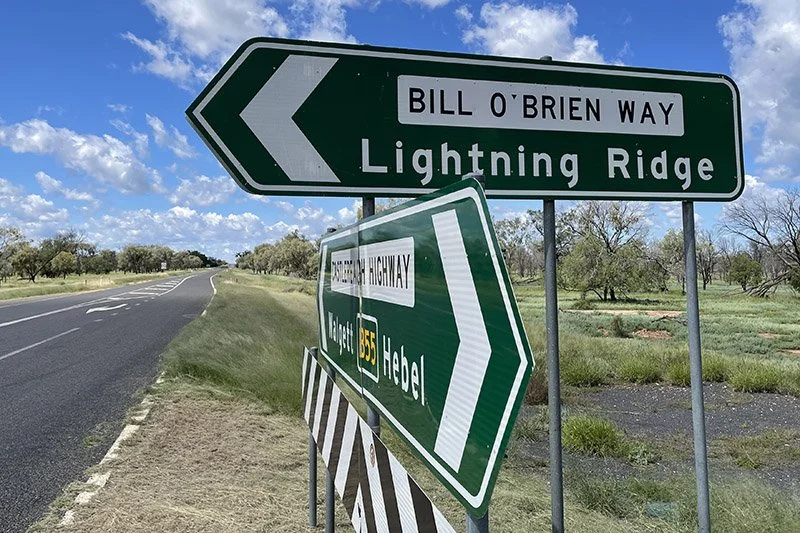
Bill O’Brien Way
Named for Bill O’Brien, owner of Woolloroo Homestead in the 1950s and first local councillor from Lightning Ridge.
Black Prince Drive
One of the parcel of famous stones found at the Telephone Line field in 1915 by Snowy Brown and Tom Urwin, the Black Prince is a spectacular round stone weighing 181.2 carats.
Brilliant Street
Named for brilliance, a term used to describe the brightness and vividness of the colour in gem opal.
Butterfly Avenue
The Butterfly stone was found in 1920 and resembles the wing of a Red Admiral butterfly.
Cardinal Road
Named for a nine carat black stone found by John Molyneux on the Telephone Line opal field.
Castlereagh Highway
Named for the Castlereagh River, although the highway’s relationship with the river stops quite some way south of Lightning Ridge. The river is named for Lord Castlereagh, a British politician in the 18th century who helped defeat Napoleon.
Crystal Road
Crystal opal is a form of black opal that appears transparent due to having no dark potch backing. Desirable for creating doublets and triplets, and can produce gorgeous stones in its own right.
Empress Crescent
One of the famous stones found by Urwin & Brown at the Telephone Line field in 1915, Empress of Australia was dropped on the floor and broke into pieces.
Fantasia Street
This street is named for a two carat bright stone found by Bobby Ward at the Nine Mile. It was bought by Greg Sherman for £100 in the 1960s.
Fireball Street
Fireball street was named for the Fireball (Or Fire Ball) stone, found by Jack Simpson and Eric Reece on the Three Mile in 1957. The stone was cut by Mick Bauer. Fireball Street is planned street that would have extended south from Butterfly Avenue, parallel to Opal Street/Fred Reece Way. For many years, there was a street sign for Fireball Street, but no entrance had been cut through the kerb of Butterfly Avenue. The sign is no longer there.
Flamingo Street
Named for the lesser of the famous stones found by Urwin and Brown at Telephone Line in 1915. Little is known about Flamingo as it was eclipsed by its more impressive companion stones.
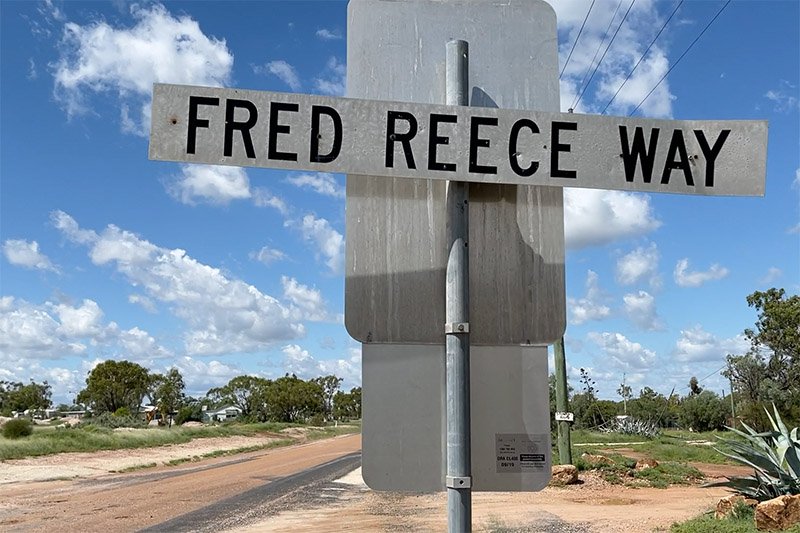
Fred Reece Way
Named for Fred Reece, local aboriginal elder, blacksmith, axeman, carpenter and handyman.
Gem Street
A gem is a precious stone; opal is Australia’s National Gemstone.
Halley’s Comet Street
A 1,982 carat monster nobby found at Lunatic Hill on the Three Mile in 1986, coinciding with the appearance of Halley’s Comet in the sky.
Harlequin Street
Named for the rhomboid colour pattern that appears in top-quality Lightning Ridge black opal. The harlequin colour pattern is named for the famous clown in Italian comedic theatre, who wore a colourful suit of diamond shapes.
Jack Murray Corner
Named in 1994 for Jack Murray, the first opal miner at Lightning Ridge (per The Opal Book, Frank Leechman, 1961).
Kaolin Street
Kaolin (or kaolinite or china clay) is a soft, white, silicate mineral common in opal-bearing ground. “Kaolin” is generally pronounced “KAY-oh-lin” in geological circles, however the local pronunciation of the street name is “kay-OH-lin”.
Kopi Street
A local term for bulldog shale, a grouping of cretaceous mineral deposits comprised largely of mudstone and claystone.
Lapkalle Street
Named for a stone found by a miner named Kalle, who hailed from Lapland.
Lightning Ridge Cemetery Road
Road leading to the Lightning Ridge cemetery.
Lorne Road
Named for Lorne Station, a pastoral property and farmstay to the south-east of Lightning Ridge.
Matrix Street
Matrix opal is any form of opal where liquid silica has seeped into and merged with sandstone or another material and hardened in-situ to form a compound. Not generally desirable in Lightning Ridge opal. Andamooka and other opal fields produce matrix opal primarily. Matrix opal may require treatment with oil or acid to enhance the play of colour.
Moore Street
Not actually a street in Lightning Ridge, but rather a dirt lane in the neighbouring small town of Angledool. Moore street is named for the Moore Family: Robert Lismore Moore, first to find opal at Lightning Ridge and his formidable wife Frances Moore who eradicated alcohol from Angledool Station and wrote extensive diaries documenting life in the area from 1882-1942.
Morilla Street
Named for the word for “low hills” in the Euahlayi/Yuwaalaraay language. Morilla is the official spelling used on signage and maps, however variants are common: Morella, Moorilla.
Nettleton Drive
Named for Charlie Nettleton, founder of the Lightning Ridge black opal industry.
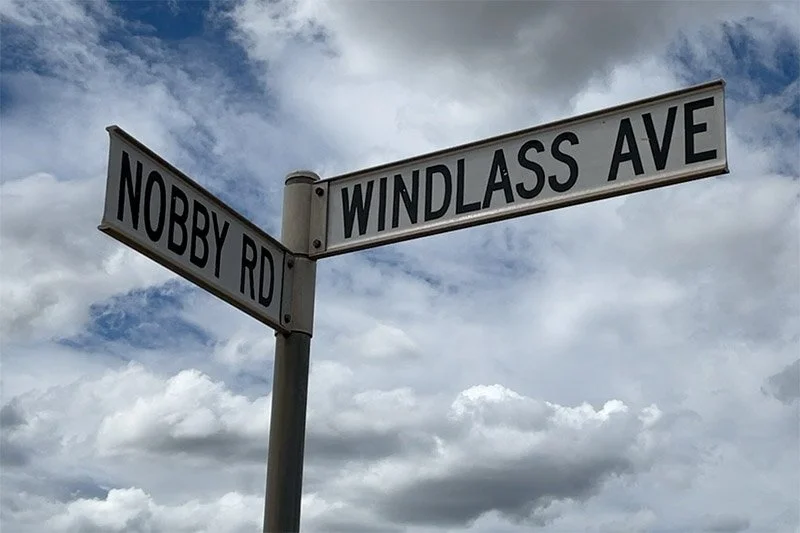
Nobby Road
Named for the nodular opal formation found at Lightning Ridge. Nobbies form when liquid silica has seeped into a bubble or cavity in the claystone. Typical nobbies have horizontal bars of potch and colour with a white pointed ceramic cap on top. The term “nobby” may have originated from Charlie Nettleton’s father’s nickname.
Onyx Street
A form of chalcedony, usually dark, sometimes banded. Can be found in the surface gravels on the ridges surrounding Lightning Ridge.
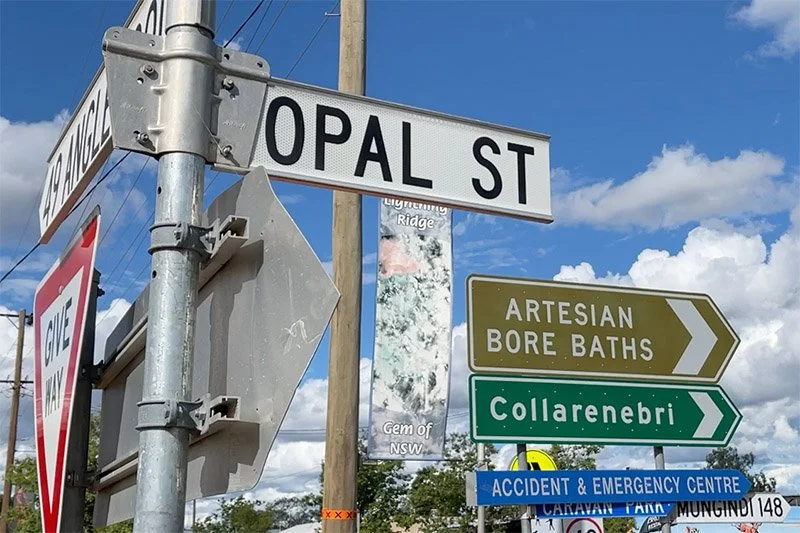
Opal Street
Named for Australia’s National Gemstone and Lightning Ridge’s main industry — and the beautiful stone we all know and love.
Pandora Street
The Pandora stone was found in 1928 by Jack McNicol on the Angledool opal field at Lightning Ridge. It weighed some 800-900 carats and was exhibited all over the world.
Petticoat Lane
An unofficial name for the laneway dividing the block between Morilla, Harlequin, Opal and Brilliant Streets.
Pinfire Street
The pinfire colour pattern in opal is a fine-grained pattern of tiny dots. Pinfire Street is an unsealed road that wends its way behind Opal Street, joining Pandora Street.
Potch Street
Common opal, or potch, is opal that features no play of colour. Potch at Lightning Ridge is commonly black, white, or grey. It can also be various shades of beige and brown, and can appear transparent and yellowish, referred to as “honey potch”.
Rainbow Street
This street is named for the Rainbow stone, found by George Low in 1933 at the Deep Four Mile.
Red Admiral Place
A cul-de-sac named for the Butterfly stone, resembling a British red admiral butterfly.
Red Robin Street
Named for the Red Robin stone, 25 carats, found by Neville Bell at Shearer’s Six Mile in 1970. It sold for $10,000 per carat.
“As a result of Neville Bell finding a large black opal, called the “Red Robbin”, near Thorley’s Six Mile, during May last, hundreds of claims have been pegged and numerous new shafts sunk.”
Shincracker Street
A hard, brittle sandstone layer just below the surface. Old-timer miners, sinking shafts by hand, would hit the material with their mining picks sending shards of sharp stone towards their legs, hence shincracker.
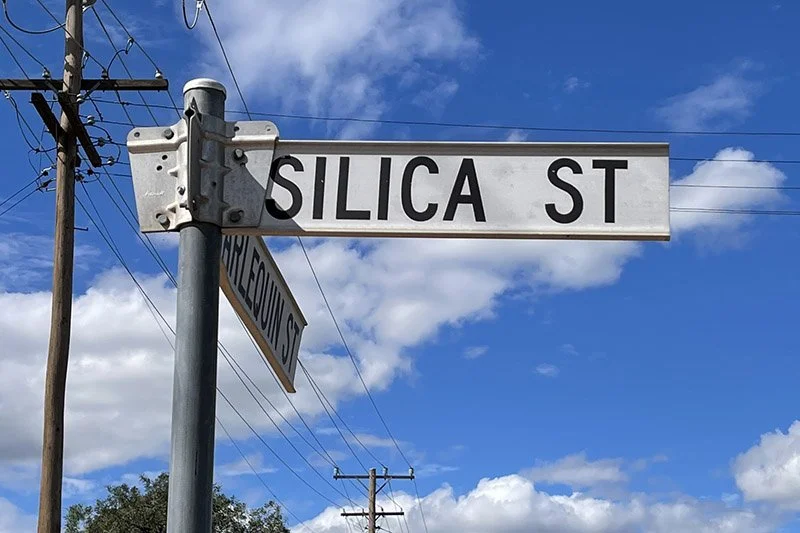
Silica Street
Opal is comprised of hydrated amorphous silicon dioxide, or silica. 100 million years ago, liquid silica seeped into cavities in the claystone, where it remained to form precious opal.
Stoney’s (White) Road
Alternative route from Fred Reece Way to the Airport/Aerodrome via the Three Mile. Unofficially named for Gary Stone, opal miner, innovator and engineer. Known as Stoney’s White Road due to being regularly topped with pure white opal dirt as road maintenance.
Sunflash Street
A kind of opal that produces bright, vivid colours in direct sunlight, but appears dull under natural or dim light.
Three Mile Road
The Three Mile opal field was one of the earliest opal rushes at Lightning Ridge, with some 1,200 miners working there in the early years of the 20th century. Now the location of the Australian Opal Centre, Chambers of the Black Hand and Fred Bodel’s historic camp, among other sights.
Windlass Avenue
Named for the hand-operated mining winch used to haul buckets of opal dirt from a mine to the surface.
Woolooroo Road
Named for Wooloroo Station, a pastoral property to the north of Lightning Ridge.

Article: Research by Russell Gawthorpe and Leisa Carney, edited by Russell Gawthorpe. LRHS research compiled by Len Cram and Barbara Moritz. Sources: Lightning Ridge - The Home of the Black Opal: Unique to the World, Gan Bruce, 1983, pp. 51-54; The Lightning Ridge Prospector, 2001, insert map, p. 60.