
Sir Dudley de Chair
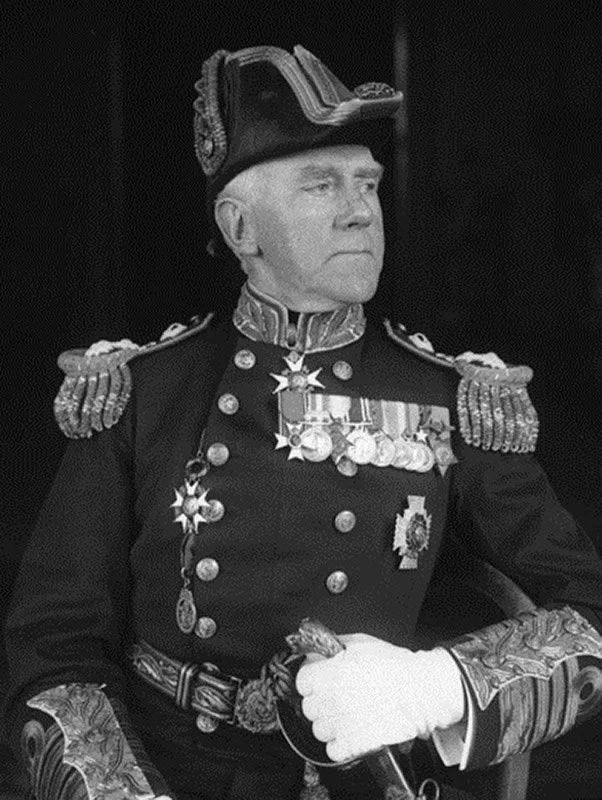
Sir Dudley de Chair, 1924. Photograph: State Library of New South Wales.
Sir Dudley Rawson Stratford de Chair was Governor of New South Wales from 1923 to 1930. Born at Lennoxville, Quebec, on 30 August 1864, the son of Dudley Raikes de Chair and Frances Emily de Chair (nee Rawson), and a nephew of Admiral Sir Harry Rawson. The family returned to England in 1870. De Chair entered the Royal Navy in 1878, served in the Mediterranean. He saw action in Egypt, held captive under Arabi Pasha for a period. He was promoted to Captain in 1902.
He married Enid Struben at Torwood, Devon, on 21 April 1903; they had two sons and a daughter.
During World War I, de Chair commanded the Tenth Cruiser Squadron, responsible for the North Sea blockade of Germany, and later the Third Battle Squadron. He was promoted to Rear Admiral in 1915, appointed K.B.E. in 1916, promoted to Vice Admiral in 1917 and to Admiral in 1920. In 1921–23 he served as president of the inter-allied commission on enemy warships.
De Chair was appointed governor of New South Wales in 1923.
The de Chair family already had connections to the opal industry prior to their Vice-Regal visit to Lightning Ridge, with Lady de Chair having corresponded with Percy Marks on multiple occasions regarding gifts of Lightning Ridge opal to Buckingham Palace, among other subjects.
De Chair visited Lightning Ridge in 1926 and perhaps also 1928, visiting during regular tours of north-western New South Wales. The governor and his party were welcomed by schoolchildren and townspeople, with a formal reception in the hall, where John Landers spoke on behalf of the community. The visitors visited shallow opal mine workings on the field and then travelled to Bob Austin’s famous claim on the Cleared Line.
“Sir Dudley de Chair visited his dwelling. The Vice Regal touch:- Bob Austin pushed Lady de Chair’s buttock, when she was climbing a dump. She promptly objected to such help.”
De Chair climbed down the 60-foot shaft to see the opal-bearing level, while Lady de Chair impressed with her knowledge of opal mining and its history.
Sir Dudley’s term as governor ended in April 1930. He retired to England, was appointed K.C.M.G. in 1933, and later published his autobiography, The Sea is Strong. He died at Brighton on 17 August 1958, aged 93, his ashes were scattered in the English Channel.

Article: Research by Russell Gawthorpe and Leisa Carney, edited by Russell Gawthorpe. LRHS research compiled by Len Cram and Barbara Moritz. Sources: ‘Black Opal Resembles Queen Victoria’, Sydney Morning Herald, 1923; ‘Lightning Ridge - The Governor’s Visit’, Walgett Spectator, 3 June 1926; ‘Mr. Doe Leaves Hospital, Will Accompany Governor to Part of Sturt Electorate’, Barrier Miner, 17 May 1926, p. 4; ‘Australian Gems - Lady de Chair Opens Exhibition’, Sydney Morning Herald, 3 April 1930, p. 15; The Lightning Ridge Book, Stuart Lloyd, 1967, p. 39; Lightning Ridge - The Home of the Black Opal: Unique to the World, Gan Bruce, 1983, p. 62; A Journey With Colour: A History of Lightning Ridge Opal 1873-2003, Len Cram, 2003, pp. 130, 153-155.