
Freddy Leiske
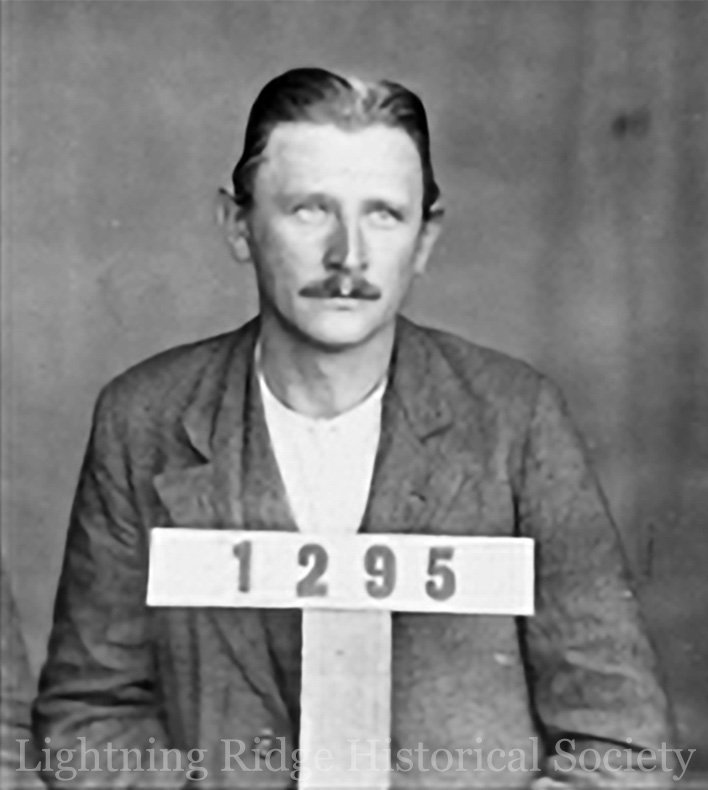
Freddy Leiske photographed during internment. Photograph: National Archives of Australia.
Fritz Frederick “Freddy” Leiske (also Lisky, Linsky, Leisky) was born in Germany around 1884. Little is known of his early years before arriving in Australia, but by the years following World War I he had settled at Lightning Ridge. He was mates with Mick Bauer and George Low. Like many of German descent, he was interned during the war years.
Leiske and Low worked together for a number of years. Their first success came at Canada’s, about 200 yards west of Holden’s, where they got good black opal for several seasons. The partners also worked at the Deep Four Mile, where Leiske and Low’s claim was among the best on the field.
Leiske is also credited with giving Hatter’s Flat its name:
“It beats me how this field ever started — you’d have to be as mad as a bloody hatter to even walk over this country, let alone sink a bloody shaft on it.”
Leiske was described as “a bonzer little bloke,” in the words of Gan Bruce. He worked steadily through the 1920s and 1930s.
Leiske died in an unfortunate way on 4 August 1945, suffering a fatal bowel obstruction after swallowing a piece of orange and died in an ambulance on the way to Walgett Hospital. He was about 61.

Article: Research by Russell Gawthorpe and Leisa Carney, edited by Russell Gawthorpe. LRHS research compiled by Len Cram and Barbara Moritz. Sources: The Lightning Ridge Book, Stuart Lloyd, 1967, pp. 37, 67, 72; Lightning Ridge - The Home of the Black Opal: Unique to the World, Gan Bruce, 1983, pp. 87, 89.