
Cecil Hammond
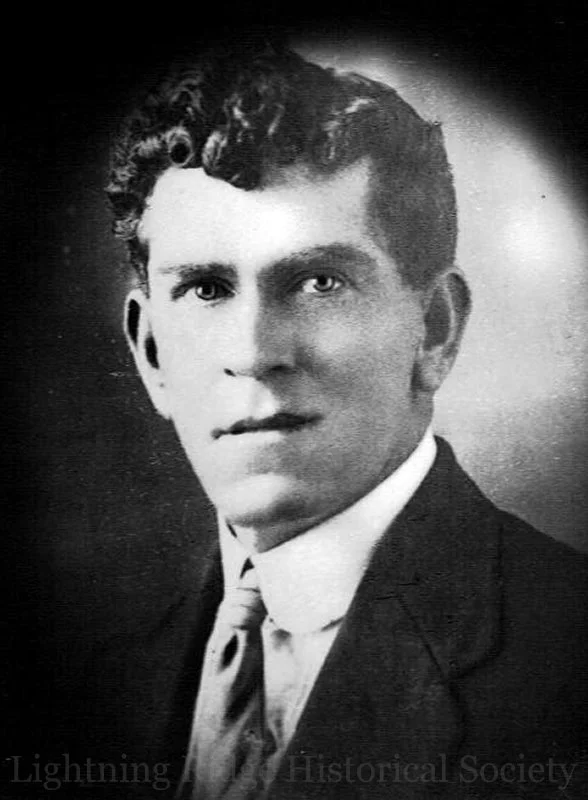
Cecil Golding Hammond. Photograph: Brian Hammond, ancestry.com.au.
Cecil Golding Hammond was born on 9 May 1888 at Angledool, New South Wales, son of Joseph Hammond and Elizabeth Hammond. He was one of a large family, growing up at Goodooga, where the Hammond family worked as shearing contractors. Of the twelve children, Cecil, along with his brothers Walter and George, would later become opal miners at the Grawin and Lightning Ridge.
By the mid-1900s, the Hammond brothers were working at the Grawin. Although surface traces had been found earlier by Charles Saunders, it was in 1908, while working between shearing sheds, that Cecil, Walter, and George Hammond struck seam opal. Their discovery prompted the first significant rush at Grawin, and Hammond’s Hill took its name from the brothers.
One stone from Cecil Hammond’s claim would later become famous. A large green opal, shaped like a coiled rope, was used as a doorstop at Hammond’s hotel at Angledool. Eventually sold to Pappa (Jack) Francis for between £5 and £7, the stone was taken to America, where it sold for around £2,000. The stone was known as Big Ben.
Cecil Hammond was also a publican, he operated the Thallon Hotel in Queensland before later licensing the hotel at Angledool. Like many early opal miners, he moved between business ventures - mining, contracting, and hotel keeping - as the opportunities arose.
Cecil married Clare Daisy Pratt, with whom he had four children. Following her death, he married Hazel P. Brindley in 1926 at Moree, New South Wales.
Cecil Golding Hammond died on 12 February 1962 at Toowoomba, Queensland, aged 73, and was buried there.

Article: Research by Russell Gawthorpe and Leisa Carney, edited by Russell Gawthorpe. LRHS research compiled by Len Cram and Barbara Moritz. Sources: The Lightning Ridge Book, Stuart Lloyd, 1967, pp. 74-78, 80, 158.