
Bob Potts
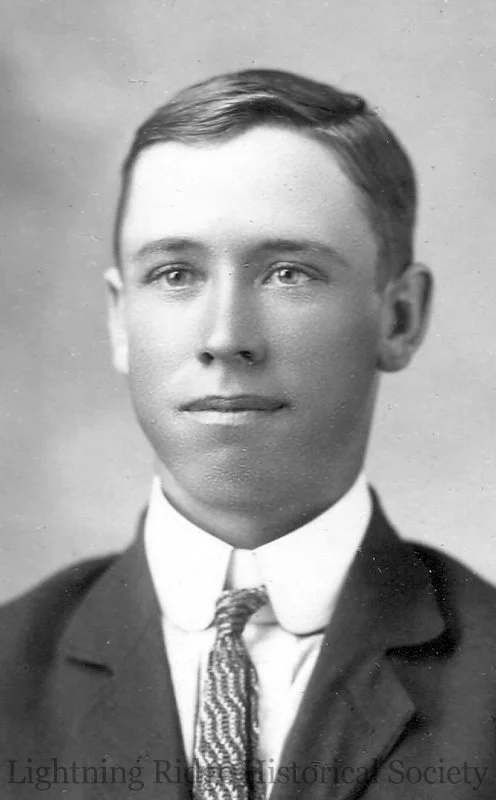
Bob Potts. Photograph: Lola Cormie, ancestry.com.au.
Robert “Bob” Potts (Jr.) was born 19 September 1891 at Gulargambone, New South Wales, son of Robert Potts (Sr.) and Jane Potts. In 1895, the family moved near Cumborah. His father later bought land at Wee Warra, including what would become known as Hammond’s Hill on the Grawin.
He married Olive Miriam Sutton, with whom he had one daughter, and later married Daisy in 1929.
Potts was one of the earliest miners at the Grawin. In 1908, he and his father, Bob Sr., sank one of the first shafts during the initial rush at Hammond’s Hill, at a time when there were only a handful of men on the field. Much of the opal found was large grey seam material, often too big for the Lightning Ridge cutters to handle with their equipment.
Bob Potts signed a petition for a mail service at Wallangulla in 1905. Potts was also a nephew of Donald McKechnie, an early shopkeeper at Old Town from 1905, and originally worked as a gold prospector before turning to opal mining. He served in World War I, and in later years led the first Anzac Day march held at the Grawin.
“Bob Potts, who has the honor of being the first man to sink a hole at The Grawin, still occasionally drives his car to the busy Sydney suburb of Bankstown. A World War I veteran, Bob Potts spent considerable time prospecting for gold in Western Australia and opal mining at The Grawin and Lightning Ridge.”
Beyond mining, Potts was a skilled well-sinker, bore-driller and blacksmith. He operated boring equipment in the search for water and put down two subartesian bores for the Government at the Grawin, neither of which proved successful. He sank a 200-foot well, fully timbered with cypress pine, which supplied water during periods when water would otherwise have to be carted from Cumborah, 12 miles away. He also worked as a contract driller.
“His nickname was ‘Never Bottom Bob’. He worked by himself sinking shafts, and when he got to a depth where he couldn’t throw the dirt out by himself, he would say to himself: “This [bloody] hole is no good’, and get up and leave it.”
Despite living frugally, he saved a lot of money, a fact revealed during a 1942 court appearance over the theft of a sheep, when he produced bank books showing several thousand pounds in his accounts. He was remembered as eccentric but harmless, meticulous about roads, and with exceptionally sharp eyesight well into old age.
Robert Potts died on 13 March 1975 at Bankstown, aged 83.

Article: Research by Russell Gawthorpe and Leisa Carney, edited by Russell Gawthorpe. LRHS research compiled by Len Cram and Barbara Moritz. Sources: The Lightning Ridge Book, Stuart Lloyd, 1967, pp. 74-75; ‘Moozeum’, Western Magazine, 2 April 1973, p. 1; Walgett Spectator, 1 August 1973; Lightning Flash Newspaper, 22 May 1975, 21 September 1989; A Journey With Colour: A History of Lightning Ridge Opal 1873-2003, Len Cram, 2003, pp. 316, 319, 321, 327, 339-340.