
Wallangulla, “Old Town”
Located on the slopes of Sim’s Hill, Wallangulla was the first settlement at Lightning Ridge.

Old Town in 1909.
The site of Wallangulla village was reserved in 1881, marked out as a three-mile square beginning at a point about 900 metres from the public tank on Barraneal, which is just to the south-east of town.
Around 1903, the time of the discovery of opal, a small settlement developed at the base of Sim's Hill, not far from Wallangilla Tank on Bundinbarrina Run, Dunumbral Station. The village was called Wallangulla, which is a derivation of the paddock “Wallangilla”. It became known locally as Old Town after a New Town was officially laid out and gazetted in 1908.
Sid Sharkey, owner of the billiards room and general store, described the town to the Mungindi News in August of 1906:
“There is no public house at the camp, the residents so far objecting to a license being granted, there are two butchers, a couple of bakers, but no store of any account. Meat is now selling at 3d per pound, whilst bread is retailed at 4d per loaf; board for miners 16d per week. The only drawback to the progress of the field is the scarcity of water, but the Government is putting down a large tank, which, it is expected, will meet all requirements for some time to come. It is anticipated that as soon as the rain comes a very large number of men will find remunerative employment on the field, the future success of which is secured.”
By 1907, there were 350 residents at Wallangulla. As per the 1907 map by government surveyor Mullens, Opale School, a post office, shops and dwellings are present. Even the rocks and trees are noted on tree map.
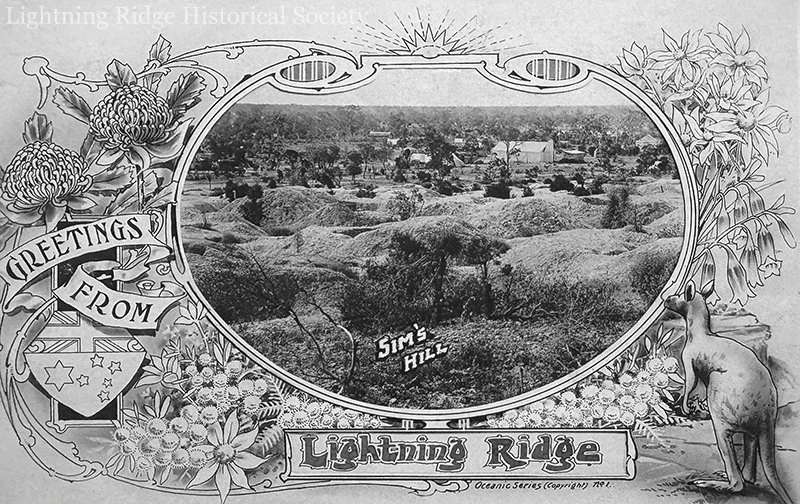
Old Town in a picture postcard, 1910.
Ted Murphy, one of Lightning Ridge’s earliest resident opal buyers, provided a wonderfully vivid description of the Old Town to the Walgett Spectator in 1906:
“There Is a butcher’s shop, kept by Mr. J. W. Prentice. Mr. Prentice’s father was on old Mt. Browne in the early days. Some of the finest meat I have seen for years is retailed a 4d per lb all round. Mr. D. McKechnie keeps the principal store, and has now been appointed postmaster. There is also a store kept by a Hindoo and known as the Indian store.
Until recently Mr. McKechnie ran two stores, one at each end of the field, but as he could not attend properly to both, the Indian store scored heavily during his frequent absence. Mr. Sharkey, from Mungindi, has announced his intention of erecting a store, tobacconist shop, fancy goods and shaving saloon, also a billiard table.
A Chinaman from Angledool was to build a store and baker’s shop, but I suppose they are waiting for further development and more population. Mr. Jefcott supplies the finest bread I have tasted in my travels at 5d per loaf; until the recent rise in the price of flour it was only 4d. The Yank supplies liquid refreshments at 3d per mug in a large bough shed known as the “Bull and Bush.” Tables, light seats and cards are supplied to card players who play the rubber of whist or cribbage for hop beer and bread and cheese. There are two shooting galleries, bobs table, and a miniature billiard table.
Drinking water is retailed by Mr. Gallegos at 2d per bucket of 4 gallons, and picks pointed at three different places at 1d points.
Visitors to the field can be supplied with meals or first class board by Mrs. R. Kirkpatrick but as there are no lodgings I would advise them to bring their own bluey.”
It is believed that Wallangulla (also Wallangilla, Wallangarra) means “hidden fire stick” in local language.
Wallagulla, or “Old Town” thrived until the Three Mile rush broke out in 1908, when the population flocked instead to the Nettleton settlement.
The Lightning Ridge Historical Society produces a map reproduction based on 1907 survey data by surveyor A. W. Mullen, with artwork by local artist Phil Heskett. The map can be obtained from the Lightning Ridge Historical Society heritage gallery.

Article: Edited by Russell Gawthorpe. LRHS research compiled by Len Cram and Barbara Moritz. Sources: ‘Reserves from Sale as Site for a Village’, New South Wales Government Gazette, 12 September 1881, iss. 360 (supplement), p. 4661; 'Lightning Ridge', The Moree News, 7 August 1906, p. 6; Walgett Spectator, 20 July 1907, 21 March 1908, 24 December 1909, 4 August 1911, 11 September 1913; The Lightning Ridge Book, Stuart Lloyd, 1967, pp. 107-108; The Opal Book, Frank Leechman, 1961, p. 74.