
Tom Urwin
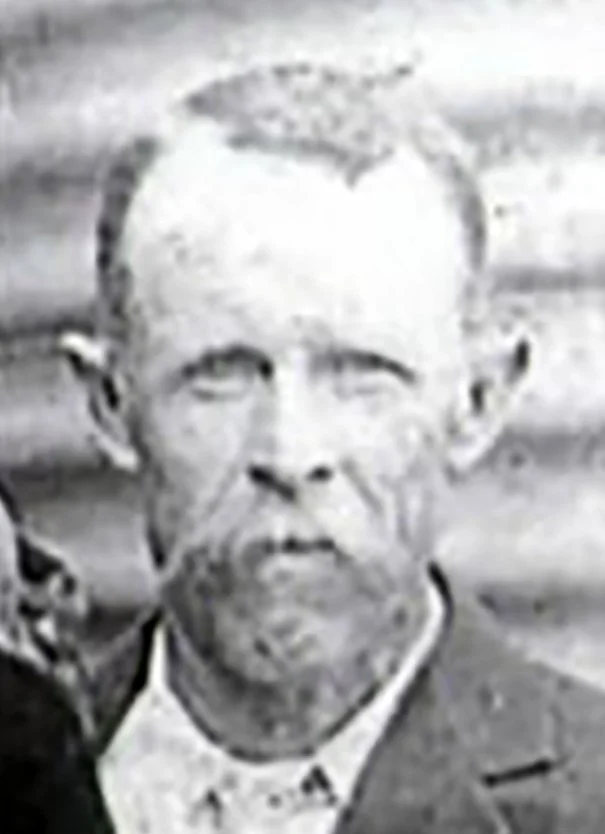
Tom Urwin. Photograph courtesy of Betty Bruce.
Thomas “Tom” Urwin (sometimes Irwin) was born on 29 December 1871 at Boggabilla, NSW, son of Joseph Dawson Urwin and Elizabeth Ann Austin.
Urwin arrived at Lightning Ridge in 1908 with Ted “Snowy” Brown. Both had previously been on the Platina tin field and reached the Ridge on bicycles. Their early mining attempts on New Town Hill were unsuccessful until, after heavy rain, they drove into an abandoned shaft and found opal valued at £720, money that enabled Snowy to bring the Brown family north. The family camped at what became known as “Circus Gully”, later Hatter’s Flat.
In 1912 Tom Urwin married Minnie Adelaide Brown at St George’s Anglican Church, a church he helped build that same year. He also built their first home in Harlequin Street (later more commonly known as Michael’s Nursery) and a second house in Morilla Street after the loss of their infant son in 1915. The family later moved into the back of the grocery shop after 1918.
Tom Urwin built, or helped to build many early permanent buildings at Lightning Ridge. Among those attributed to Urwin are: St George’s Anglican Church, 1912; Urwin & Brown matrimonial house (Harlequin St), 1912; Nyghyah’s Shop (later Urwin’s Store), 1915; The Bruce Home & Police Station, 1915–16; Bush Nursing Association Cottage, 1915 (built with Ronald McDonald); Second Post Office, 1914; Second Town Hall, 1918 (built with Ronald McDonald) and the Second Tennis Courts, 1929.
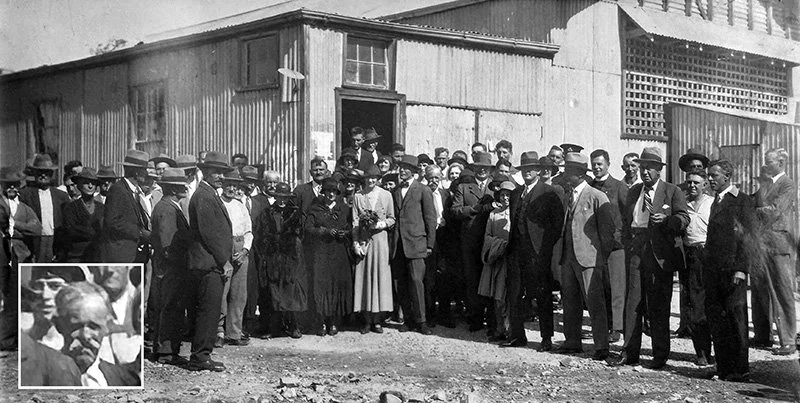
Tom Urwin (centre of crowd and enlarged in inset) during Governor Phillip Game’s visit to Lightning Ridge in 1934. Photograph: Lightning Ridge Historical Society.
In 1915, on a small wedge-shaped claim on the Telephone Line field, Tom Urwin and Snowy Brown found several stones that made history: Pride of Australia, The Black Prince, The Empress of Australia, and the Red Flamingo, among unnamed others from the same pocket. The opals were described as large, clean nobbies, rich red-orange on jet-black potch, many with harlequin pattern. The stones were sold several years later to Ernie Sherman for £2,000, considered a ludicrous amount to pay for opal at the time.
In 1917, Urwin and Brown prospected on what became known as Urwin and Brown’s Shallow Four Mile, bottoming at nine feet on a seam of gem opal. They sold approximately £5,000 from the claim, keeping the opal quiet due to earlier thefts while mining on the Cleared Line.
In 1918 Urwin bought the shop he had originally built for Charles Nyghyah. In 1922 Lightning Ridge’s first petrol bowser was installed in front of the store.
Tom Urwin passed away on 3 April 1942 in Lightning Ridge, and is buried at Lightning Ridge Cemetery.

Tom Urwin’s signature sourced from a letter protesting the relocation of residents from Old Town and The Flat to the surveyed town, 7 February 1912.

Article: Research by Leisa Carney, edited by Russell Gawthorpe. LRHS research compiled by Len Cram and Barbara Moritz. Sources: Walgett Spectator, 25 February 1926, 6 June 1929; The Lightning Ridge Book, Stuart Lloyd, 1967, p. 140; Lightning Ridge - The Home of the Black Opal: Unique to the World, Gan Bruce, 1983, pp. 46, 54, 65, 71, 72, 140, 164, 167, 170; Lightning Ridge: Turning Back Time - A Heritage Trail, Barbara Moritz, 1998, pp. 8, 13, 16-18, 20, 22, 27, 32; A Journey With Colour: A History of Lightning Ridge Opal 1873-2003, Len Cram, 2003, p. 175.