
George Brown
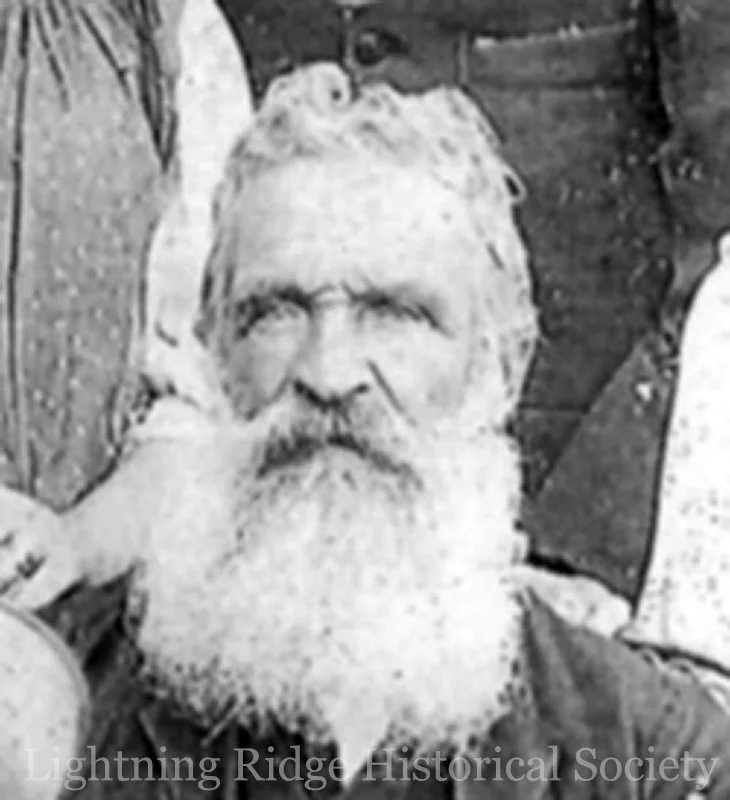
George Thomas William Kincaid Brown was an early Lightning Ridge opal miner during the first decades of the 20th century. Brown was born on 19 March 1845 in Stepney, Middlesex, England, the son of William and Hannah Brown. By the 1870s he had settled in Peak Hill, New South Wales.
In 1875, Brown married Ellen Matilda Page (1856–1925) at Forbes. They had 13 children in a span of 24 years, including son Edward Charles “Snowy” Brown.
George Brown and family moved to Lightning Ridge well after 1901. He was issued a miner’s right in 1909, working with fellow miner Jack Martin, earning some £420 in ‘09. George scored a further £500 from the Hatter’s Flat field.
Frank Leechman describes Brown being present at Tom Urwin’s claim when the Empress of Australia stone was found.
Con Colleano (Sullivan) brought to town “The Ocean Wave”, a ‘razzle dazzle’ or carnival-style ride similar to a round-about or witch’s hat. George purchased this machine from him for £20 and charged 3 pence per ride.
Brown’s name appears in the ledger of Regan’s Store between 1912 and 1921.
George Brown died at Lightning Ridge on 16 June 1918, aged 73, and is buried at Wee Waa General Cemetery.

Article: Research by Leisa Carney, edited by Russell Gawthorpe. LRHS research compiled by Len Cram and Barbara Moritz. Sources: ‘Walgett’, Daily Observer (Tamworth), 25 June 1918, p. 6; The Opal Book, Frank Leechman, 1961, p. 201; The Lightning Ridge Book, Stuart Lloyd, 1967, pp. 13, 69, 123; Lightning Ridge - The Home of the Black Opal: Unique to the World, Gan Bruce, 1983, pp. 88, 167, 169.