
Darkie Anderson
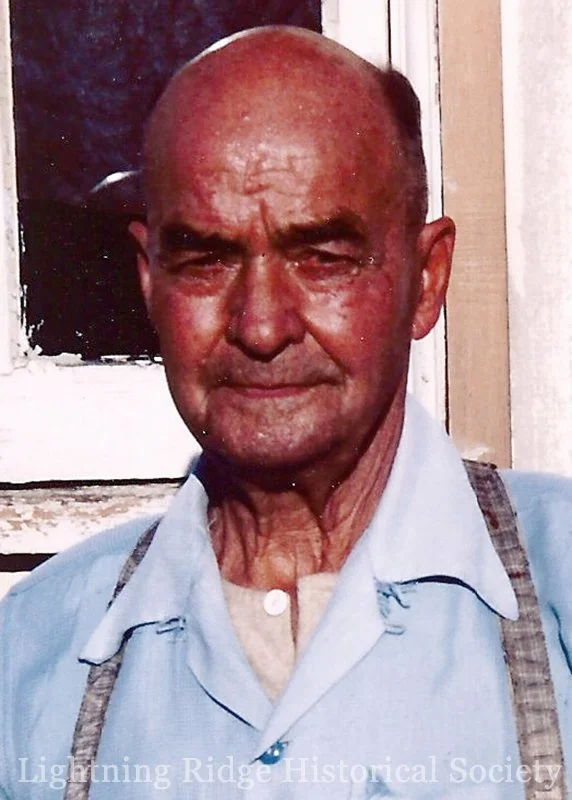
William “Darkie” Anderson. Photograph: Simon Mamouney, ancestry.com.au.
William “Darkie” Anderson (sometimes Darky) was one of the earliest opal miners at Lightning Ridge, particularly on the Pony Fence and Three Mile fields.
Anderson’s history is difficult to peg accurately, for a number of reasons. A key factor in Darkie Anderson’s loose background is his appearance as a somewhat fictionalised version of himself in Ion Idriess’s Lightning Ridge (1940), where it is not possible to be certain the exploits attributed to Anderson occurred. (This is even more convoluted when one considers that Idriess’s book features a completely fictional main character also named Darkie!) Further, there are two other miners with similar names: Darkie Robinson and Darkie Andrews referenced in literature that may or may not be seperate individuals to William “Darkie” Anderson, and the facts about their lives may be conflated.
Anderson was at Swan Hill, Victoria, on 4 October 1878, to parents Mary and William. In 1910 he married Minnie Louisa Pedley, a cook on Angledool Station. The couple had two children.
He worked as a drover before turning to opal mining. Anderson was at the Ridge by 1907, with a good claim on Pony Fence. Anderson had one of the three best claims on that field, alongside George Bailey and Walter Arnold.
In June 1907, Anderson, Archie Gillespie and Mick Cullen prospected south of Nobby and picked up surface trace near what became the Three Mile Flat. According to John Landers, their early holes produced good colour and helped trigger the rapid development of the Three Mile, which soon became one of the Ridge’s richest fields.
Anderson sank the first shaft at the Deep Three Mile, abandoning it at 51 feet, with others sinking deeper and ultimately finding opal.
Anderson held Miner’s Rights in 1909 and 1910, and after leaving the fields worked as a butcher.
William “Darkie” Anderson passed away in Sydney on 12 December 1967, aged 89 and is buried at Rookwood Necropolis.

Article: Research by Leisa Carney and Russell Gawthorpe, edited by Russell Gawthorpe. LRHS research compiled by Len Cram and Barbara Moritz. Sources: Walgett Spectator, 10 November 1921, 17 November 1921; Lightning Ridge: The Land of Black Opals, Ion L. Idriess, 1940; ‘Lightning Ridge’, The World’s News, 26 April 1941, p. 17; ‘Lightning Ridge’, The World’s News, 3 May 1941, p. 15; The Lightning Ridge Book, Stuart Lloyd, 1967, pp. 59, 102; Lightning Ridge - The Home of the Black Opal: Unique to the World, Gan Bruce, 1983, pp. 89, (132); A Journey With Colour: A History of Lightning Ridge Opal 1873-2003, Len Cram, 2003, pp. 147, 149.