
Bob Bishop
“Opal was much easier to find here in the early days. Why, we used to talk about how many stones we knocked out in a day! It is easier to work on your own. Prepare 4 to 6 buckets at a time and use a 3-pronged hook. By jove, Chas. Nettleton was a good mate and a born prospector.”

Bob Bishop. Photograph; Lightning Ridge Historical Society.
Arthur William “Bob” Bishop was born at Cassilis, New South Wales, in 1883, son of Ted Bishop “The Opal King” and Maria Hart.
Bishop’s family moved to the Walgett district around 1893, with his father selecting land at Come-by-Chance.
Bob first came across to Lightning Ridge around 1900, moving across to work in 1903-1904, living and mining at the Nobby.
Bishop was a carpenter by trade, having contributed to the contstruction of many buildings across the district that were still standing in the 1960s.
He mined with Charlie Nettleton at Yowah and Koroit, Queensland in 1908 and later with Bert Cooper when he returned to Lightning Ridge in the 1940s.
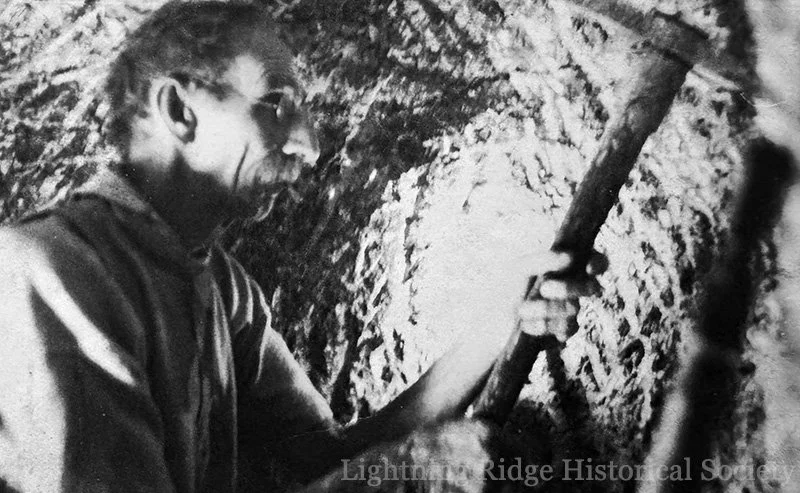
Bob Bishop mining. Photograph: Lightning Ridge Historical Society.
The following audio recording features Bob Bishop in 1961 talking about his adventures opal mining in Queensland with Charlie Nettleton.
Transcript: We poked about there. We done no good, then we went went out to another place called Koroit, further out. (Koroit? That's the name of the station, yeah?) Yes, we sunk…Charlie and I sunk a duffer there, 47 feet, and we bottomed on shincracker, so we left! We came back here.
(Refer Charlie Nettleton’s profile for a further audio recording of Bob Bishop.)
Bob Bishop passed away in April of 1963 and is buried in the Church of England section of the Lightning Ridge Cemetery.

Article: Research by Leisa Carney, edited by Russell Gawthorpe. LRHS research compiled by Len Cram and Barbara Moritz. Sources: ‘Obituary - Arthur William Bishop’, 1963, newspaper unknown; The Book of Opals, W. C. Eyles, 1964, p. 92; The Lightning Ridge Book, Stuart Lloyd, 1967, pp. 18, 35-36; Lightning Ridge - The Home of the Black Opal: Unique to the World, Gan Bruce, 1983, pp. 70, 75.